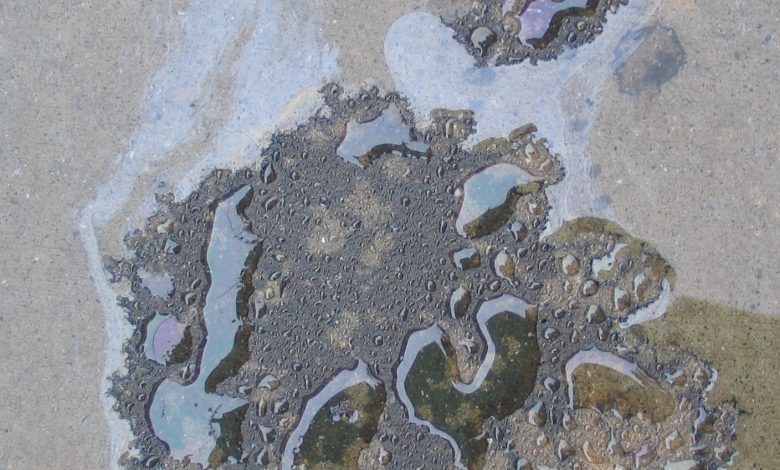
A fresh spot beneath a parked car deserves attention, but its position and color rarely identify a failed component by themselves. Fluids can run along covers, collect on a protective panel, and drip somewhere far from the source. The owner’s useful role is to capture the pattern, check permitted fluid levels, and give the workshop clear evidence.
Establish what is actually changing
Note where the vehicle was parked, how long it stood, and whether the spot appeared after a journey or during several idle days. A clean sheet of cardboard can help show location and approximate spread without requiring anyone to crawl beneath the car. Remove it before operating the vehicle and dispose of contaminated material appropriately.
Compare accessible fluid levels using their proper procedures. Engine oil should be checked under the specified conditions, and coolant should be assessed cold. An apparently normal level does not rule out a small leak, especially when the container holds much more fluid than the amount reaching the ground.
Map the drip without chasing it
Note the parking position, elapsed time, and whether the spot follows a journey. Compare permitted fluid levels using their own procedures. A stain on the ground marks where fluid arrived, which may be some distance from the component that released it.
Treat appearance as a clue
Fresh engine oil, old transmission fluid, and other lubricants can overlap in appearance after use. Dirt changes color further. Water from normal condensation can also leave a wet patch. Avoid tasting fluid or deliberately inhaling fumes to identify it. Photographs and a description of consistency are safer than improvised identification tests.
A stain near the front of the engine might originate at a higher seal and travel down a casting. Conversely, fluid on a lower panel might move rearward during driving before dripping. Tell the technician the observed location while leaving the source open to investigation.
| Clue | What it contributes | What remains uncertain |
|---|---|---|
| Spot beneath a parked vehicle | Location and recurrence of external loss | The source may be higher or farther forward |
| Wetness after cleaning and rechecking | Evidence of fresh leakage | Which seal or component is responsible |
| Rapid loss or a pressure warning | Reason for prompt action under vehicle instructions | A normal-looking puddle size cannot establish safety |
Distinguish a seep from active loss
A damp joint discovered during inspection and a puddle that reforms after every journey represent different patterns. Neither should be assessed solely by the size of an old stain. Ask whether the area was cleaned and rechecked, whether fresh wetness appeared, and whether fluid levels are changing.
For example, residue remaining after a previous filter change can resemble a continuing oil leak. Cleaning and a controlled follow-up may resolve the uncertainty. However, assuming every wet surface is leftover service residue can delay repair of an actual sealing problem. Evidence after cleaning is what separates those possibilities.
Know when monitoring is insufficient
A rapid level drop, fluid reaching hot components, smoke, overheating, or an oil-pressure warning calls for prompt action rather than a longer observation diary. Follow the vehicle instructions and stop operation when required. Do not reach beneath a running vehicle or touch hot surfaces to locate the drip.
Ask a qualified workshop to inspect inaccessible sources. Pressure testing, controlled cleaning, or approved tracing methods may be needed. Replacing the lowest wet component without tracing the path can leave the original problem untouched.
A leak diagnosis follows fresh evidence back to its source, rather than replacing the lowest wet part.
Editorial takeaway
Document the repair outcome
After repair, establish clean baseline readings and check the same parking location again. Record what was repaired and whether the area was cleaned. A disappearing stain and stable levels are more useful evidence than a single glance immediately after collection, when residual fluid may still obscure the result.
Featured image: 2006-10-24 oil-puddle.jpg by Roger McLassus, CC BY-SA 3.0. Image reproduced without editorial alteration; WordPress may create resized display copies.