Start with energy rather than fuel
An electric car stores energy in a traction battery and uses an electric motor to turn its wheels. Understanding the journey between those two components makes dashboard information easier to interpret. The battery is not simply an oversized version of the small battery that powers accessories. It supplies the propulsion system, while control electronics continuously coordinate how much power the motor receives.
Think about leaving a parking space. Pressing the accelerator requests movement from the control system. The car checks operating conditions and delivers an appropriate response. The pedal does not mechanically open a passage from the battery to the wheels. Software and electrical hardware translate the request into controlled motor torque.
Separate energy storage from power delivery
The battery stores energy, while the motor and electronics control how quickly it becomes motion. A large battery does not by itself establish acceleration, and a powerful motor does not tell you how far a charge will last.
Follow the path through the electronics
The traction battery stores electrical energy as direct current. In many electric vehicles, an inverter converts that supply into the controlled alternating current used by the traction motor. By changing its output, the inverter controls motor operation across a wide range of driving conditions. Owners do not need to adjust or service this equipment.
The distinction between energy and power matters here. Energy describes the amount available to use, while power describes how quickly energy is being transferred. A brief uphill acceleration can require substantial power without consuming a large share of the battery’s total stored energy. A gentle drive lasting several hours can consume much more energy overall.
| Component | Main role | Ownership implication |
|---|---|---|
| Traction battery | Stores electrical energy | Available energy changes with use and conditions |
| Inverter and controls | Regulate electrical delivery to the motor | Requested output stays within system limits |
| Motor and reduction gearing | Produce and transmit rotation | Road demand determines how much energy motion requires |
Connect motor movement to road movement
The motor creates turning force, usually delivered through reduction gearing and a differential. The reduction gearing helps match motor speed to useful wheel speed. Many electric cars do not need the multiple shifting ratios familiar from conventional automatic transmissions. That does not mean the vehicle has no gears or mechanical components requiring attention.
Immediate response at low speed can make parking feel different. Practice small accelerator inputs in a clear, permitted area and learn the car’s creep and hold settings. A quiet powertrain is still capable of moving suddenly. Keep the brake applied whenever selecting a driving direction, and confirm the displayed gear before moving.
Account for systems beyond propulsion
Not every unit of battery energy reaches the road. Cabin heating, air conditioning, battery temperature management, lights, and electrical conversion all use energy. Tires also deform as they roll, and air resistance increases the effort needed to maintain speed. These normal demands explain why identical distances do not always consume identical battery percentages.
For example, a short winter errand may spend a noticeable amount of energy warming the cabin relative to the distance traveled. A longer journey spreads that initial comfort demand over more miles. This does not automatically indicate a battery fault; the context of the journey matters when comparing consumption.
Electric propulsion becomes easier to understand when stored energy and the rate of using it stay separate.
Editorial takeaway
Use the explanation in everyday ownership
Watch energy consumption over complete trips rather than interpreting every change in the power gauge as lost range. Strong acceleration, hills, weather, and accessories all affect the flow of energy. Use the owner’s manual to understand the displays and leave high-voltage diagnosis, exposed wiring, and propulsion repairs to qualified technicians. The practical goal is to recognize normal behavior and describe unusual symptoms clearly, not to access the electrical system yourself.
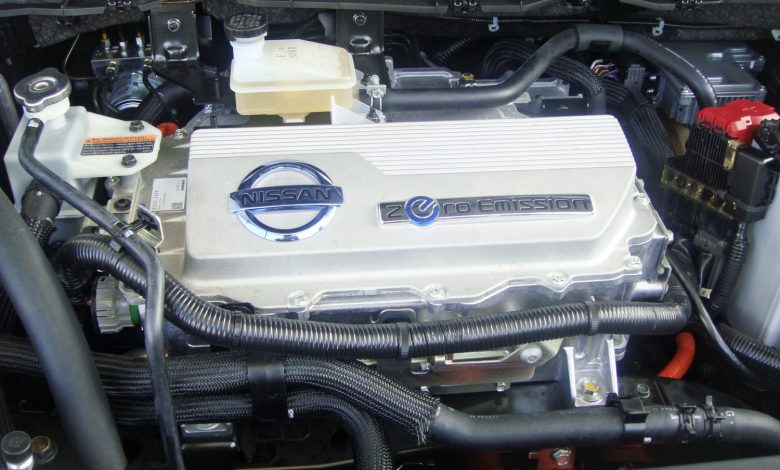
Featured image: Nissan Leaf electric motor DC 03 2011 1647 by Mario Roberto Duran Ortiz (Mariordo), CC BY-SA 3.0. Image reproduced without editorial alteration; WordPress may create resized display copies.