How Sound Insulation Changes the Character of a Car Cabin

A quiet cabin results from controlling several routes by which sound and vibration reach occupants. Thick carpet alone cannot solve every noise problem. Designers work with seals, glass, body panels, mounts, absorbent materials, and the shape of cavities. Understanding these different paths explains why two cars can sound very different on the same road.
Tire condition can change the acoustic impression over time. Uneven wear or an unfamiliar new sound should prompt a condition check rather than an assumption that the cabin has suddenly lost insulation.
Airborne noise needs barriers and seals
Wind, surrounding traffic, and some mechanical sounds travel through air. Gaps around doors or windows can provide direct routes into the cabin. Glass and other barriers influence how much sound passes through, while seals must remain properly seated. A whistle that appears after window replacement may therefore suggest an installation issue rather than inadequate insulation throughout the car. The location and conditions of the noise provide useful clues.
Compare on a repeatable route
Use similar roads, speeds, and ventilation settings when comparing cabin sound. Note where a sound seems to come from and when it changes; a newly appearing noise deserves investigation rather than a quick attempt to cover it with extra insulation.
Structure can carry vibration
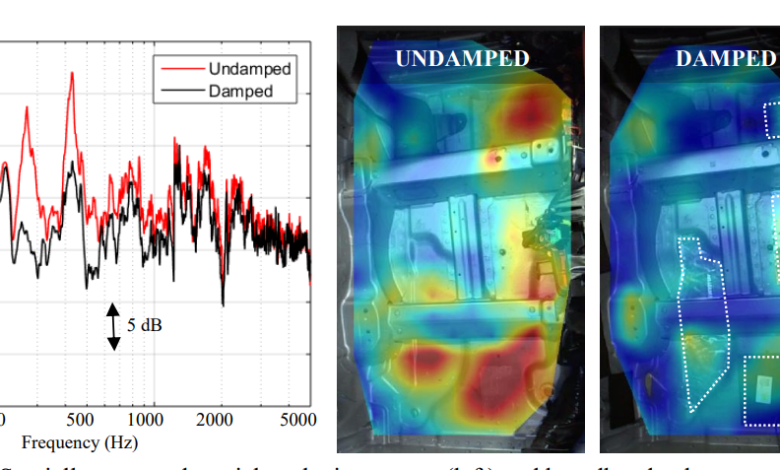
Tires create vibration as they interact with road texture. Some of that energy travels through suspension attachments and body structures before radiating as sound inside. Designers can alter mounts, panel shapes, and damping treatments to manage these paths. Adding foam to a door pocket is unlikely to address a vibration entering through the floor. The underlying route matters more than the apparent proximity of a noisy surface.
Absorption and damping are different tools
Soft porous materials can absorb some sound within cavities, reducing reflections. Damping materials attached to panels reduce certain resonant vibrations by dissipating energy. A barrier works differently again by resisting sound transmission. These functions are often confused in aftermarket descriptions. Material thickness, placement, attachment, and suitability for moisture and temperature all matter. Randomly filling cavities can interfere with drains, wiring, or moving parts.
| Sound path or treatment | Main idea | Limit of a quick judgment |
|---|---|---|
| Airborne sound | Noise reaches the cabin through air paths | Loudness alone does not identify the entry point |
| Structure-borne vibration | Motion travels through connected parts | A trim rattle may need more than added padding |
| Absorption or damping | Different treatments address different behavior | One material is not a universal noise cure |
Quietness is not the absence of information
A completely isolated impression is not the only design objective. Drivers still benefit from useful cues about engine effort, tire behavior, and surrounding activity. Some cabins emphasize a calm background while allowing particular sounds to remain recognizable. Perceived refinement also depends on sound quality: a steady low hum may be less distracting than an intermittent rattle, even when neither seems especially loud in isolation.
The quietest impression is most useful when you know what road, settings, and sounds produced it.
Editorial takeaway
Assess noise under repeatable conditions
Compare vehicles on similar surfaces and at comparable speeds, with ventilation and audio settings understood. Notice whether the dominant noise comes from wind, tires, an engine, or a loose interior part. Remove unsecured cargo before diagnosing a rattle. Persistent new sounds deserve appropriate inspection rather than indiscriminate insulation. The practical conclusion is that cabin quietness is a coordinated engineering result. Owners get better outcomes by identifying the sound path and correcting faults than by assuming every noise needs more padding.
Featured image: Vehicle damping soundproofing by Dani Fernandez Comesana, CC BY-SA 4.0. Image reproduced without editorial alteration; WordPress may create resized display copies.