Incomplete maintenance records create uncertainty about what fluids are present and when they were last renewed. The solution is not to change every fluid blindly or assume a clean appearance means everything is current. Establish the vehicle’s requirements, separate confirmed facts from unknowns, and build a sensible baseline with a qualified workshop.
Collect evidence before choosing work
Gather invoices, service-book entries, and any labels left by previous workshops. Look for dates, mileage, specifications, and the actual work performed. An entry saying ‘service’ may cover only engine oil, while a detailed invoice may show coolant replacement and a separate gearbox procedure.
Mark uncertain items explicitly. If a receipt confirms a filter but says nothing about the fluid, do not convert that omission into a completed fluid change. Equally, a missing invoice does not prove neglect. It simply means the next decision needs to account for uncertainty instead of relying on an invented history.
Build a baseline without inventing a past
List each fluid as documented, partly documented, or unknown. Confirm the vehicle configuration before selecting a specification or procedure. Resolve the gaps through inspection and suitable service, then record the actual product and work so the same uncertainty is not passed to the next visit.
Match requirements to the exact configuration
Identify the engine and transmission variants before selecting fluids. Similar vehicles may use different gearbox families or cooling requirements. The owner’s manual and appropriate service information establish specifications, capacities, inspection methods, and replacement procedures. Generic descriptions such as automatic transmission oil are not sufficiently precise.
Ask the workshop to explain which recommendations come from the maintenance schedule and which respond to observed condition or symptoms. This distinction helps prioritize work. A currently low level or active leak is a different problem from a scheduled replacement whose previous completion cannot be documented.
| Evidence available | What it establishes | Next question |
|---|---|---|
| Detailed dated invoice | A traceable service event and identified materials | Does it match this vehicle and the current due point? |
| Stamp or vague receipt | Some work may have occurred | Which fluids, specifications, and procedures were involved? |
| Color or seller recollection | A clue worth recording | What independent evidence or assessment is needed? |
Inspect before treating
Check accessible levels and look for contamination or leakage using the correct procedures. Visual findings can indicate a need for investigation, but they cannot establish every fluid property. Dark color alone should not dictate a particular treatment, and a clear liquid should not certify compatibility.
For example, a transmission with an unknown history and a shifting complaint needs diagnosis as well as service planning. A fluid change may be appropriate, but it is not a guaranteed repair for worn components. Choosing an aggressive cleaning process before understanding the fault can add uncertainty rather than resolve it.
Create the baseline in manageable stages
Prioritize overdue or time-sensitive scheduled work and any issue affecting safe operation. Group compatible jobs where useful, while following each system’s procedure. Cooling systems may need controlled bleeding, and some transmissions require a specified temperature during level adjustment. Those details are part of the service, not optional finishing steps.
Keep samples or photographs only when the workshop finds them useful; an owner does not need to dismantle components to prove an unknown history. Spend effort on reliable identification and documentation rather than speculative tests with unsuitable household tools.
An honest unknown is a better starting point than a confident service history assembled from guesses.
Editorial takeaway
Make the uncertainty end here
Record every completed service with its specification, quantity, date, and mileage. Set the next deadline from that documented baseline. Future maintenance then becomes a planned sequence instead of repeated debate about what might have happened before the records began.
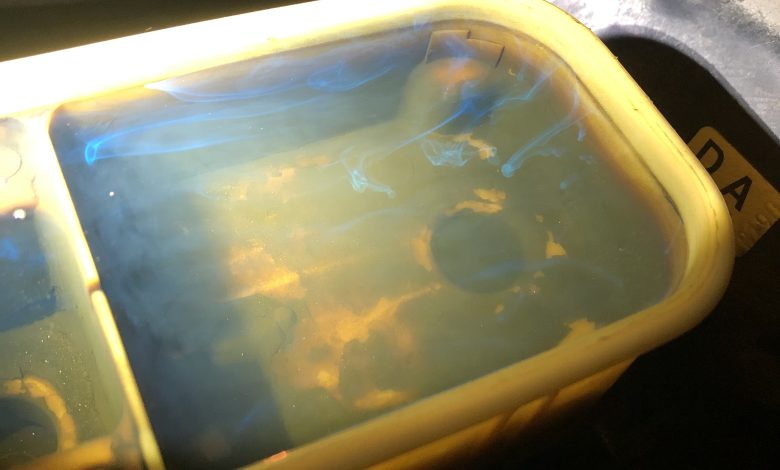
Featured image: Master Cylinder Reservoir (with particle accumulation).jpg by Joseph Blosser, CC0 1.0. Image reproduced without editorial alteration; WordPress may create resized display copies.