Let the car manage its battery temperature
An electric car has controls that manage battery operation when conditions are hot. Depending on the vehicle, these can run pumps, fans, or a cooling system while driving, charging, or parked. Owners should understand the sounds and messages described in the manual. Cooling activity after a journey is not, by itself, evidence that something has gone wrong.
Do not try to cool electrical parts with water, ice, or makeshift covers. The charging connection and battery enclosure are designed to operate as a complete system. Any warning about battery temperature or electrical faults deserves the response specified by the manufacturer, especially if it persists after the car has had time to settle.
Treat cooling operation as part of charging
Fans or pumps may run while parked or connected. Keep cooling paths clear and follow the manual; a warning, persistent fault, or unusual heat deserves assessment rather than improvised attempts to defeat thermal management.
Match charging to the next journey
Hot weather does not create a universal charging percentage that suits every battery. Follow the charging limits and storage guidance for your specific car. Consider the next departure when choosing when to charge. If an unusually high target is needed for a long trip, a supported schedule can help reach it closer to departure.
For example, a car parked through a hot afternoon may not need its long-trip target until early the next morning. Scheduling can align charging with that requirement. Check that the selected window leaves enough time for the energy needed, and avoid assuming that every charger or household connection can supply its rated output continuously.
| Situation | Useful response | Avoid assuming |
|---|---|---|
| Long sunny parking before a trip | Use supported scheduling and preconditioning | That every car needs the same charge target |
| DC rate falls during a session | Check charge level, conditions, and vehicle messages | That the charger alone is responsible |
| Cabin cooling while parked | Account for the energy used | That stationary means no battery consumption |
Understand changes in charging speed
A charger advertises a maximum capability, but actual power depends on the vehicle, its state of charge, battery temperature, and the available supply. Thermal management may affect the rate. A slower session on a hot day therefore needs context before being described as a fault. Note the displayed conditions and any messages.
When planning a journey, leave room for ordinary variation in session length. Arriving with a tight appointment and no alternative charger makes any delay harder to manage. If the car repeatedly charges much more slowly than expected under similar conditions, consult its documentation and ask a qualified service provider to assess the pattern.
Make parked comfort part of the plan
Cabin cooling uses energy, particularly when a sun-heated interior first needs to cool down. Use supported departure conditioning where it fits your parking and power arrangement. Shade and appropriate sun protection can improve comfort, but keep ventilation openings clear and follow the manufacturer’s advice about covers and parked settings.
Never treat climate control as an assurance that a parked vehicle is safe for an unattended child or animal. Systems can stop, power can be interrupted, and settings can be misunderstood. For ordinary travel, prepare the cabin while you remain responsible for occupants and make comfort decisions that preserve clear attention and visibility.
Let thermal management do its work, and plan charging around the energy the next journey actually needs.
Editorial takeaway
Keep the routine simple
Inspect the accessible charging cable and connector for obvious damage before use, and stop if equipment looks unsafe or displays a fault. Keep a record of repeated warnings rather than experimenting with electrical fixes. In hot weather, the most useful habits are vehicle-specific charging settings, realistic time allowances, and respect for the car’s temperature controls. These support predictable use without attempting to manage the high-voltage system yourself.
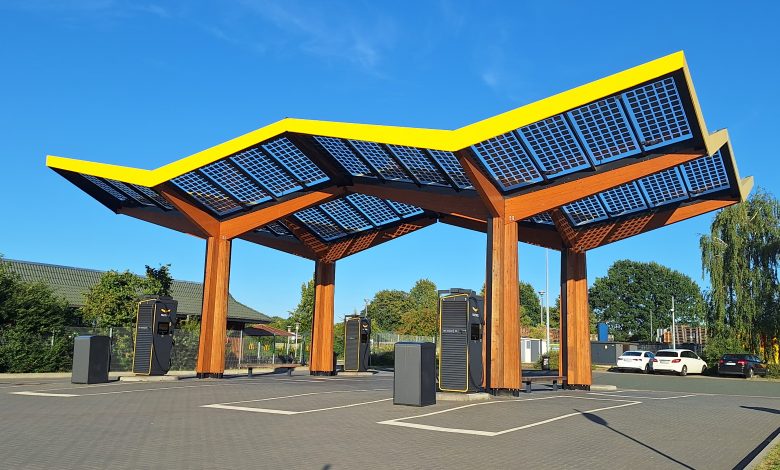
Featured image: Fastned Hermsdorf-Ost charging station by Steffen Mokosch, CC BY-SA 4.0. Image reproduced without editorial alteration; WordPress may create resized display copies.