
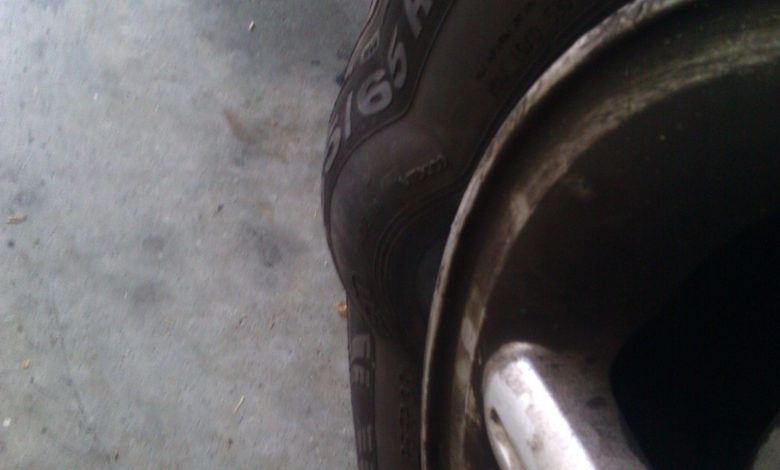
The sidewall is a structural component
A tire sidewall does more than display size and branding. Its internal cords help contain pressure and carry repeated loads as the tire rolls. A localized outward bulge can indicate that this reinforcement has been damaged, allowing the pressurized rubber to push outward. The tire may still hold air and have deep tread, but those facts do not restore structural strength. Treat a newly noticed bulge as a reason to stop using the tire and obtain qualified assistance.
Air retention is not structural reassurance
A tire with an outward bulge can still hold pressure while its reinforcement is damaged. Keep the vehicle parked if the damage is found at rest, and arrange a permitted spare or recovery. A photograph can show the location to a professional but cannot establish internal strength.
Impacts can damage layers you cannot see
A sharp pothole edge or curb strike can compress the tire between the obstacle and the wheel. The rubber may recover its shape while internal cords break. Sometimes the bulge becomes obvious immediately; sometimes it is noticed later during washing or a pressure check. The wheel may also be bent or cracked. Tell the tire professional about any recent impact, even if there was no immediate pressure warning. An inspection should consider the assembly and nearby components rather than the visible mark alone.
| Appearance | Interpretation limit | Appropriate response |
|---|---|---|
| Localized outward bubble | Can indicate damaged reinforcement despite retained air | Stop using the tire and obtain qualified assistance |
| Shallow inward indentation | May reflect normal radial construction | Have unfamiliar or uncertain contours assessed |
| Impact mark with no obvious air loss | Hidden tire or wheel damage remains possible | Report the impact and request an assembly inspection |
Distinguish an outward bubble from normal contours
Some radial tires show a shallow inward indentation where construction materials overlap. That can be a normal feature, unlike an outward bubble associated with damage. Lettering, protective ribs, and molded patterns can also affect appearance. An owner should not decide that an unfamiliar shape is harmless simply because another tire has a line in its sidewall. If the shape is new, pronounced, or uncertain, have it assessed. A photograph can help communicate its location, but it cannot establish the internal condition.
Choose a safe next step
Do not probe, cut, puncture, or try to flatten a bulge. Adding sealant will not repair broken reinforcement. If the vehicle is parked, keep it parked until a suitable spare or recovery arrangement is available. If damage is discovered during travel, stop in a safe place and arrange help rather than continuing at speed to see whether the tire survives. Use a spare only as the vehicle instructions permit, including its pressure, load, and operating restrictions.
A tire that holds air can still have lost the structural strength needed for safe use.
Editorial takeaway
Replacement should include a cause review
A structural sidewall bulge generally calls for tire replacement rather than a puncture repair. Ask the shop to inspect the wheel and check whether the impact affected alignment or suspension parts. Review tire pressures because underinflation can make impact damage more likely, although correctly inflated tires can also be damaged by severe impacts. Check the remaining tires for related marks and record the replacement details. The central lesson is that tread depth and air retention describe only part of tire condition; visible structural deformation deserves attention even when the vehicle otherwise feels normal.
Look at the inner sidewalls during professional service as well. Damage there may be hidden during an ordinary walk around, which is why an outside glance cannot certify the whole tire.
Featured image: Tire bubble.jpg by Osnetwork, CC BY-SA 3.0. Image reproduced without editorial alteration; WordPress may create resized display copies.