A dipstick provides a simple measurement, but parking angle, drain-back time, and oil smeared inside the tube can make the result misleading. The purpose is to measure the oil available in the sump under repeatable conditions. Start with the vehicle’s instructions, because some engines specify a warm check while others use a different procedure or an electronic display.
Prepare a repeatable measurement
Park on level ground and switch off the engine. Allow the specified waiting period so circulating oil can return to the sump. Checking immediately after shutdown can suggest a low level even though the correct quantity is present. A sloping driveway can push oil toward or away from the dipstick and change the reading.
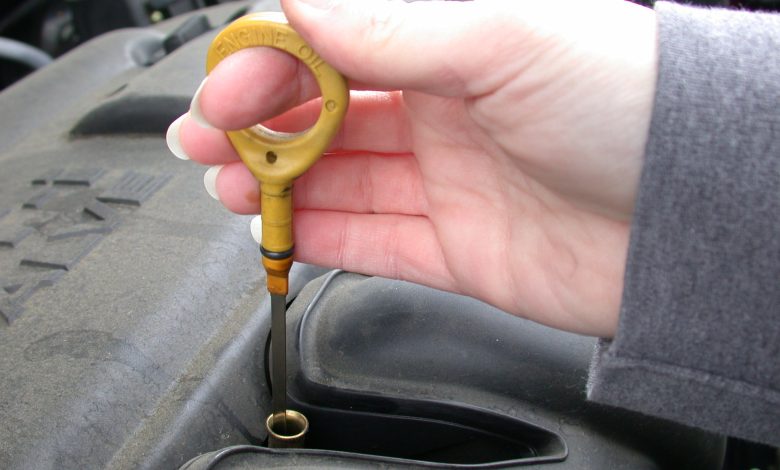
Withdraw the dipstick, wipe it with a clean lint-free cloth, insert it fully, and withdraw it again. Look at both sides. A clear continuous boundary is more useful than a streak carried up the stick by the tube. If the sides disagree substantially, repeat the measurement before deciding to add oil.
Make the second reading count
Before adding oil, repeat an unclear measurement under the same level-ground and waiting conditions. Keep a note of the amount added and recheck after it settles. The gap between dipstick marks is not a universal bottle-sized quantity.
Read the marked operating range
The minimum and maximum marks define the intended level range; they are not interchangeable with empty and completely full. Do not assume that the distance between them represents a universal quantity. The owner’s manual may state how much oil corresponds to that span, but different engines have different sump shapes and capacities.
For example, a level halfway between the marks normally calls for monitoring rather than automatically adding a whole container. Pouring a large quantity based on a vague impression can create an overfill. Excess oil can cause aeration or other operating problems, so aiming beyond the upper mark is not extra protection.
| Observation | Better interpretation | Next step |
|---|---|---|
| Different boundaries on opposite sides | Oil smeared by the tube may obscure the level | Wipe, fully reinsert, and measure again |
| Clear level inside the marked range | The level is within the intended operating band | Monitor rather than adding a guessed full container |
| Level rises across repeatable checks | Apparent quantity can change through contamination | Record the trend and request assessment |
Add oil in controlled amounts
Use oil meeting the specified viscosity and required performance approval. Clean around the filler opening before removing the cap, then use a clean funnel if access is awkward. Add a small amount, allow it to settle, and recheck. Keep track of the amount added rather than relying only on the container’s changing appearance.
If the dipstick shows no oil, do not treat that as an invitation to guess the missing quantity and continue driving. Establish the correct level before operation and investigate a sudden loss. An oil pressure warning requires a separate, urgent response; a satisfactory dipstick reading does not prove adequate pressure.
Watch the trend between checks
Record mileage and top-up amounts when consumption is noticeable. A stable pattern gives a technician better information than ‘it uses some oil.’ A rising level also deserves attention because contamination can increase the apparent quantity. Do not diagnose the cause from color or smell alone.
A reliable oil reading comes from repeatable conditions, not from the first streak on the stick.
Editorial takeaway
Finish with a clean baseline
Refit the dipstick and filler cap securely, wipe away spills, and keep a dated note of the result. Consistent checking conditions make small changes meaningful. The goal is a dependable level inside the specified range, supported by a record that helps distinguish ordinary variation from a developing problem.
Featured image: Engine oil dipstick.JPG by Dvortygirl, CC BY-SA 3.0. Image reproduced without editorial alteration; WordPress may create resized display copies.